October 10, 2026 · AI Dungeon alternative · Story-game fit test
Is this an AI Dungeon alternative for interactive stories?
No. AI Dungeon describes a turn-based, AI-guided story in which you submit actions and continue an Adventure. This site turns a sentence into a small arcade game on a canvas. In our new test, a request to choose a dungeon door and have a wizard remember our name became a five-wave Collector with 16 rune stones, not a continuing story. If you want an AI Dungeon-like game, choose by testing action input, consequences, memory and saved progress; the checklist below tells you exactly what to try.
What kind of tool should you look for?
The official AI Dungeon getting-started guide describes Do, Say and Story inputs that advance an Adventure. Its Adventure guide describes a story made of actions that can be continued later. Those are concrete features to test in any candidate, rather than judging by a fantasy title or a screenshot.
Use the same short scene in each tool you consider:
I am Mira. I carry a brass key. Two doors stand ahead: one leads left, the other right. I choose the left door and tell the guard my name.
Can you take another story turn? After the opening, look for a Do, Say or free-text action field. Type “I ask the guard what is behind the left door.” A one-time game-idea box does not meet this need.
Does the choice change what happens? Start the scene again and choose right. Compare the next prose scene, not just its title. The candidate should respond to the selected door with a different consequence.
Does it remember a fact? A few turns later ask the guard your name and whether you still have the brass key. Check the answer against the earlier turns; don't infer memory from a settings label.
Can you return to the same Adventure? Close and reopen it. Check that the old text and the next action continue from the same story, rather than starting a similar new run.
Can you correct a bad turn? Try edit, retry or undo on a mistaken response, then see whether later turns use the corrected story. The AI Dungeon guide names those controls, but test their behavior in the specific alternative you are considering.
The checklist tests behavior, not a promise that a model will always remember perfectly. AI Dungeon's own memory documentation explains why longer stories need explicit context handling.
What this site gave us instead
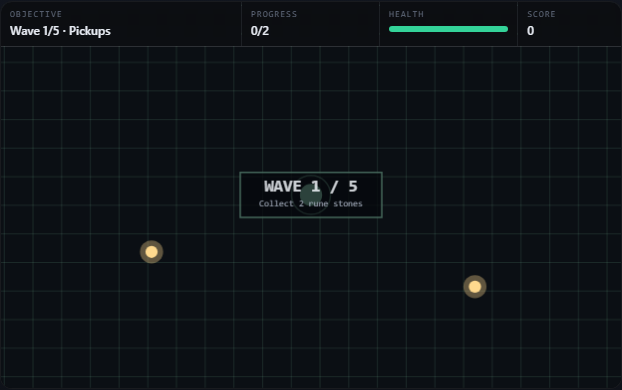
We entered “a dungeon text adventure where I choose the left door, tell a wizard my name, and the next scene remembers it” on this site's generator, leaving Game type and Visual style on Auto. The first playable result was titled “Dungeon Text Adventure”, but its rule was “Clear 5 waves: collect 16 rune stones in total.” It chose Collector and Fantasy. The opening display showed Wave 1/5, progress 0/2 and four health.
The actual result of the new story prompt: a pickup arena. The title says “Text Adventure,” while the visible goal and controls describe a Collector game.
The visible stage controls were Restart, Copy brief, Copy link and Sound. We found no text field in the game stage for the next story action and no left-or-right choice control. Holding Right moved the player from x = 311 to about 372.5, with y still 194.375. That was movement in an arcade arena, not choosing a door in a narrative.
The optional model request did not complete in this run; the page reported a local build. This test therefore measures the local result and the visible stage controls, not every possible model response. Two earlier branching-story prompts also became Collector games, and a dungeon RPG comparison changed arcade objectives when Game type changed. Those separate runs support the same product boundary without pretending that a fantasy label adds story turns.
When this tool is the right fit
Use it if you want a short fantasy-themed game with movement, hazards, pickups, score and a wave goal. Use a dedicated interactive-story tool if your goal is to speak to characters, choose actions that change prose, remember past turns and resume the same Adventure. That distinction is about the format you can play, not which name appears in the generated title.