Does This AI Game Generator Give Enemies AI Strategies?
WordstoGame enemies follow fixed movement rules; they do not learn your moves or plan coordinated attacks. The AI game generator makes a simple 2D single-player browser game. Its optional model refinement can change names and presentation, but a prompt asking for teamwork does not add a learning enemy system. Our actual result was named Flank Trap; the name did not establish flanking behavior.
Try a survival gameThe real question
In an AI-assisted game-development discussion, Splendiforus asked:
“Does the AI have strategies to beat you as a player?”
That question concerned another developer's combat demo. We tested the same underlying concern on WordstoGame: whether describing clever opponents gives this tool new enemy decision-making rules. This page reports our tool's behavior, not a test of the original demo.
The prompt and settings we actually used
We opened the live homepage in a fresh desktop Chrome session and typed this 91-character request:
a neon survival arena where smart enemies learn my moves, flank me and cooperate to trap me
- Open the generator and enter the sentence in Describe your game.
- Choose Survival dodger under Game type and Neon under Visual style.
- Select Easy; leave all three Extras off.
- Click Generate game. Read the goal and model status instead of treating an evocative title as proof of a mechanic.
- Press Restart, focus the game canvas, then use the right and left arrow keys to move while watching the hazards.
What appeared in our live run
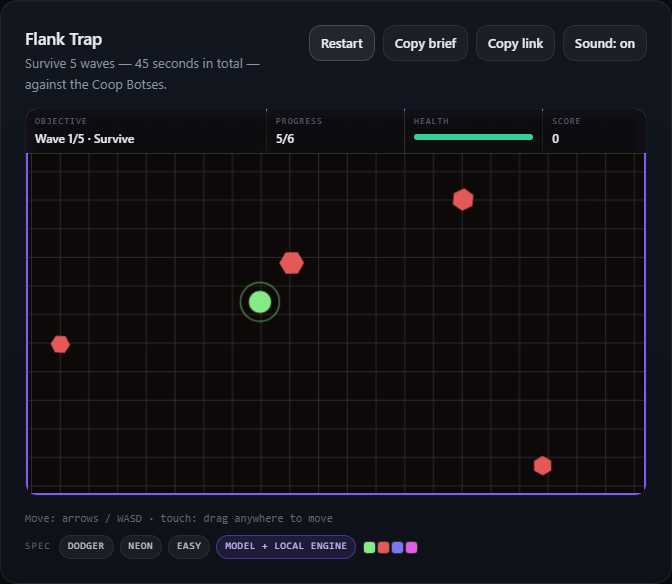
After about 33 seconds, the model-refined result was Flank Trap. The player name was Neo Runner and the enemy name was Coop Bots. The goal was to survive five waves totaling 45 seconds, with five starting health. The names matched the request's theme; the playable rule remained the available survival game.
The initial idle run had reached wave four and score 750 when we inspected it. Its snapshot included drifting enemies and a three-health elite. We then restarted to check a fresh first wave. Across 20 read-only snapshots, that restarted sample contained drift and orbit enemy types. It did not contain a chaser or an elite during that short interval, so we do not present it as a live demonstration of all four types.
With the canvas focused, right and left arrow inputs changed the player's horizontal position from 311 at the start to approximately 235 by the final snapshot; its vertical position stayed about 194.4. After approximately 5.57 seconds, the restarted run was still on wave one, with score zero and all five health remaining. We did not finish this run or verify a coordinated trap.
How we checked the enemy rules
We fetched the script served by the live site and confirmed that it matched the current local engine source. Its movement routine updates each enemy separately. Drifters move and bounce at boundaries. Chasers steer toward the player's current position. The elite uses the same direct steering branch with three hit points. The orbit type uses a fixed formula based on the player's position and a radius; it has no team planner.
There was also a visible limitation in our recorded data: some orbit enemies moved far outside the canvas. We therefore cannot call this a successful circling or encirclement demonstration. The source check establishes the fixed rule, while the live snapshots show what actually happened in this session.
No network requests occurred during the restarted observation. Combined with the source check, this supports a local movement loop rather than a model choosing tactics during play. The current engine contains no player-history learning, shared enemy strategy or prompt-defined flanking rule.
What to expect from a strategy request
Use this tool to sketch an arcade survival idea, then judge the movement and objective on the canvas. Several independent hazards can make an arena crowded without cooperating. A name such as “Coop Bots” is presentation, not evidence of teamwork.
If your idea requires enemies to remember prior attempts, assign roles or execute a designed ambush, this interface does not offer those controls. It also does not create 3D or multiplayer games or export game files. Try the available browser game and inspect the actual rule, or read more tested questions.