October 11, 2026 · Best AI game generator · First-result test
Best AI game generator: what does your first prompt actually produce?
Choose by the playable result, not the title the AI gives it. Rosebud is worth examining if you need to edit mechanics after generation; Astrocade if you want a game made for its player feed; Tesana if you need a larger world and assets. WordstoGame is for an immediate, small 2D arcade game. In our new test, a mirror-puzzle request produced a playable Collector named Mirror Puzzle I, with a goal of collecting 16 shards across five waves. It did not provide a mirror-rotation puzzle.
Compare the generated result you can check
On a phone, swipe this table sideways to read the full test question for each tool.
Someone who wants to keep editing the generated project. Rosebud describes a live browser editor with code, art, sound and published game links, and shows puzzle-game examples.
Open the playable preview. Check whether the specific mechanic you asked for works, then try changing it in the editor. These are features Rosebud publishes; we did not run our prompt there.
Someone making a short game to publish into a platform with a player feed. Its creator page describes creation, audience tools and on-platform discovery.
Play the published game and inspect its controls and win rule. We have not made or published a game on Astrocade, so its page does not tell us how well it would follow our mirror prompt.
Someone whose prompt calls for a richer game world or generated assets. Tesana's create page shows a prompt moving through assets and environment into a game, then publication.
Inspect the playable game itself, not only the asset preview. Check the game logic and whether it matches the requested scene. We have not tested that workflow in an account.
Someone who wants to try a small single-player arcade rule immediately, without an account.
Read the type, objective and controls shown beside the canvas. Its fixed choices are Shooter, Collector and Survival dodger; it cannot make an arbitrary puzzle rule or export a game file.
This is a comparison of the other companies' public product pages plus a fresh test of our own site. It is not a same-prompt quality ranking of four generators. If you are choosing by editing, ownership or export rather than the first generated result, see the separate AI game maker comparison.
Our fresh mirror-puzzle prompt: title versus game rule
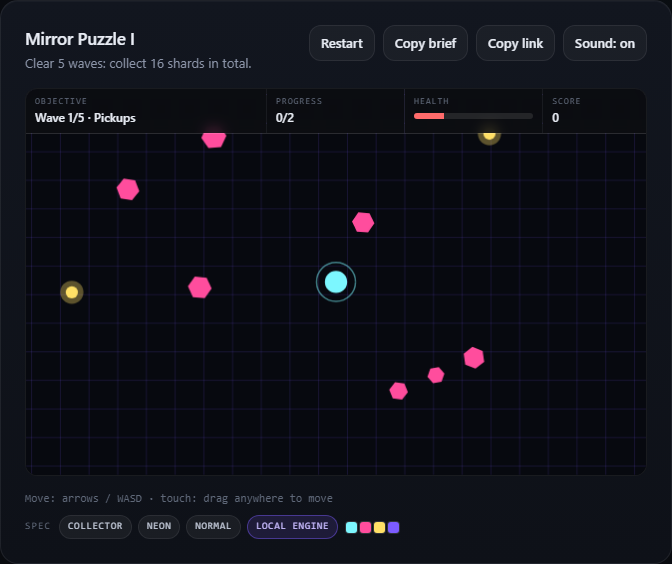
On October 11 we opened the live homepage in a fresh browser session and entered “a mirror puzzle where I rotate reflectors to guide a beam into a locked door”. We left Game type, Visual style and Difficulty on their defaults. After pressing Generate game, the page displayed a canvas titled Mirror Puzzle I. The actual rule was “Clear 5 waves: collect 16 shards in total.” The result badge said LOCAL ENGINE, and the visible controls were movement with arrows, WASD or touch drag.
The live result we captured. Its puzzle-sounding title does not match the pickup rule shown below it.
In the captured state, the HUD showed wave 1/5, progress 0/2 and score 0. There was no visible control for turning reflectors or steering a beam into a door. The game was running; we did not play all five waves. The page still reported that it was refining with the optional model, so these observations describe the local result at capture time, not a completed model response. A later wording change would not turn this observation into a tested mirror puzzle.
The specific failure is useful when selecting a generator: a name can echo your prompt while the objective and available actions follow a different template. Test the requested action and win condition before assuming the generated game matches the idea.
A quick acceptance check for any generated game
First, inspect the playable artifact. A picture, description or convincing title is not yet a working rule. Second, perform the action from your prompt. For this test, that would mean rotating a reflector and seeing the beam change path. Third, verify the win condition. A puzzle door opening is different from collecting shards across waves. Fourth, check what survives. Ask whether the exact game can be edited, resumed, shared or exported; those are separate product capabilities.
If you want a quick arcade experiment, try one sentence here and look at the result's objective before you play. If the exact mechanic matters more than speed, use a generator that lets you inspect and revise that mechanic, and test it yourself. We cannot infer the quality of Rosebud, Astrocade or Tesana from their marketing pages alone.
After the first build: three questions about improving it
AI can generate a game in minutes. Why is improving it still so hard?
Real user wording: “It's because game design and game development are two completely different things. Game development is the part that AI is making easier.” — The_Scraggler, original comment.
Because a playable build proves that rules run; it does not decide whether those rules are the ones you wanted or whether they feel good. Our mirror-puzzle test shows the first problem directly: the generated title matched the request, but its playable objective was to collect shards, not rotate mirrors. A faster second generation would not by itself prove that the missing mirror rule had been added. Inspect the actions and win condition again after every revision. On this site, the available game types remain Shooter, Collector and Survival dodger; there is no free-form editor for adding a mirror mechanic.
If movement feels bad, is the solution changing speed, acceleration, camera behavior, or level design?
Original post wording: “If movement feels bad, is the solution changing speed, acceleration, camera behavior, or level design?” The author also describes the player's complaint as “the movement feels floaty,” in the original post by Still_Ad6012.
Play once and identify the cause before asking for a change. Those alternatives are the original poster's question, not a list of controls we tested here. Check whether the player moves as intended, whether the obstacle placement creates the difficulty, and whether the camera changes what the player can see. Change one identified cause, replay the same situation, and check that the objective and controls still work. Our mirror-puzzle capture only established that movement controls were shown and a Collector rule ran; it did not measure movement feel or test a speed, acceleration or camera adjustment. WordstoGame does not expose those fine controls in its form.
If players get stuck, should the tutorial change or should the mechanics be simplified?
Original post wording: “If players get stuck, should the tutorial change or should the mechanics be simplified?” The same post by Still_Ad6012 gives “the player does not understand what to do” as an example of player feedback.
First watch where they get stuck. If the action exists but players cannot find it, clearer instructions may help. If the action does not exist, instructions cannot repair the rule: in our test there was no visible way to turn a reflector, so a tutorial about turning mirrors would mislead the player. Retest the playable rule after a change. We have not run a player usability study for this page or tested whether another generator would fix the mirror puzzle.